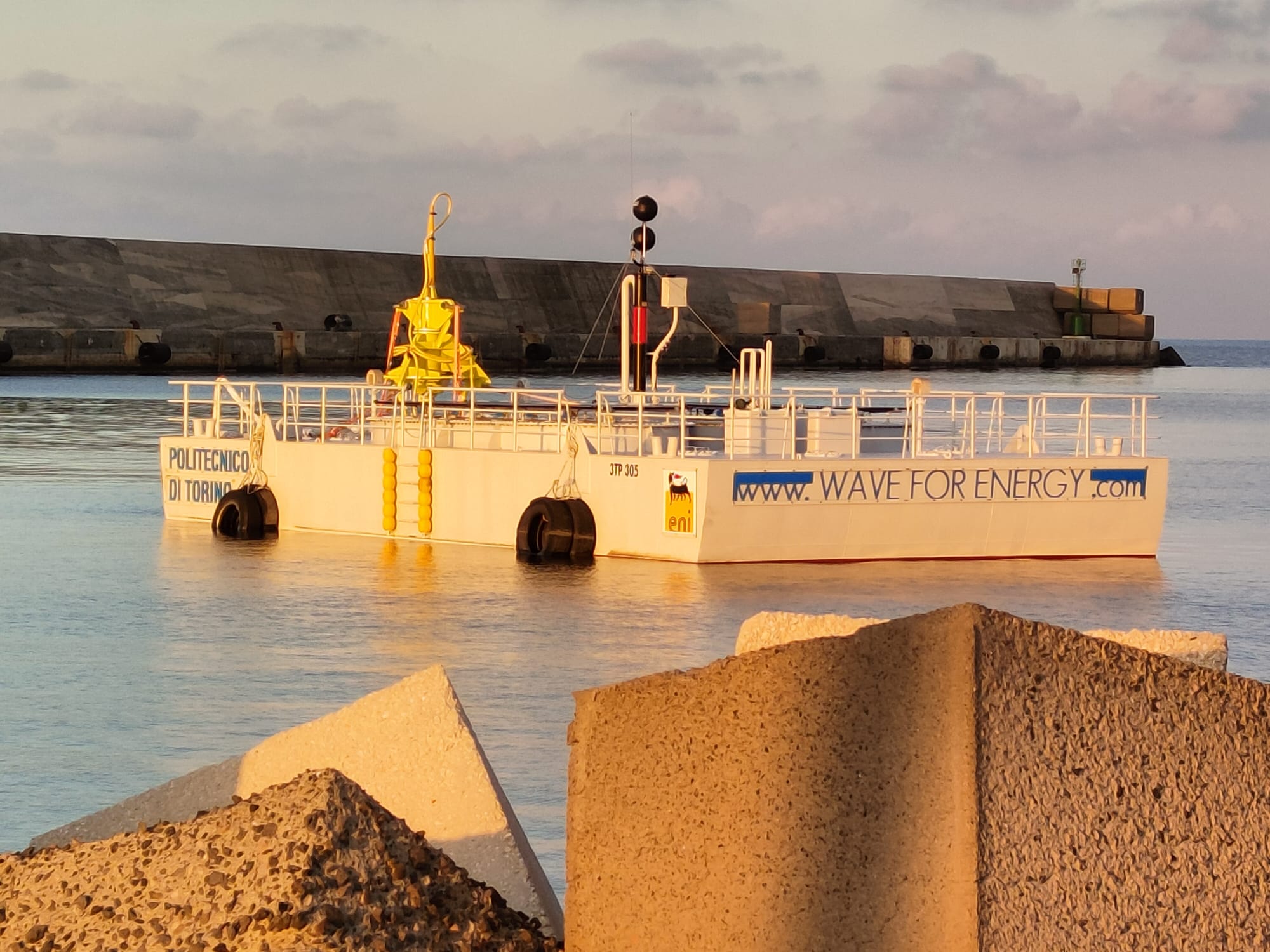
In December 2022, Wave for Energy returned to Pantelleria to prepare a new round of open-sea tests on the ISWEC wave energy converter ahead of the grid-connected installation completed in March 2023. This article summarises that pre-grid campaign and links it to the longer Pantelleria story that began in 2015. The campaign focused on verifying upgraded subsystems, mooring behaviour, and control software under winter sea conditions—de-risking the final connection to the island network and the higher-rated two-gyro configuration deployed with Eni.
Context after the 2015 prototype
The 2015 machine demonstrated Italy’s first full-scale ISWEC but operated largely in stand-alone mode with a single gyroscopic unit and resistive dissipation while export permits progressed. Peer-reviewed analyses of those trials documented performance around 4.6 kW/m average wave power density and informed control improvements. By 2022, partnership with Eni and Politecnico di Torino had matured through Adriatic hybrid-grid operation offshore Ravenna, setting stricter reliability targets for Pantelleria’s second chapter.
Objectives of the 2022 test programme
Engineering goals included validating mechanical interfaces for the dual-gyro layout, exercising active control across a wider sea-state envelope, and confirming communication links for remote monitoring. Teams also rehearsed installation sequences—tow-out, mooring hook-up, and cable handling—that would be repeated during grid connection months later.
Winter deployments intentionally stress survivability: shorter daylight, higher sea states, and limited weather windows expose weaknesses in logistics and crew procedures before a device is tied to paying grid assets. Findings fed directly into safety cases submitted to regulators.
Technical focus areas
Key checks covered gyroscope start-up torque limits, generator grid synchronisation readiness, and mooring line tension monitoring. The swivel-based mooring system designed to align with wave direction underwent inspection after exposure to sustained swell. Electrical systems were tested for insulation and harmonic content expected by the island utility once export began.
Data acquisition compared measured pitch spectra with numerical models calibrated on Ravenna experience. Discrepancies triggered recalibration of hydrodynamic coefficients used in Eni’s HPC-based site optimisation workflows.
Environmental and stakeholder coordination
As in 2015, work proceeded in coordination with marine monitoring partners and local authorities responsible for navigation and habitat protection. Noise and vibration measurements continued to benchmark ISWEC against background levels, supporting arguments that slack-moored floaters can coexist with fishing and tourism when sited away from sensitive shallow habitats.
Community briefings on Pantelleria emphasised the upcoming grid connection’s potential to offset diesel generation, linking technical tests to tangible energy-security benefits residents recognise.
Refurbishment and marine logistics in late 2022
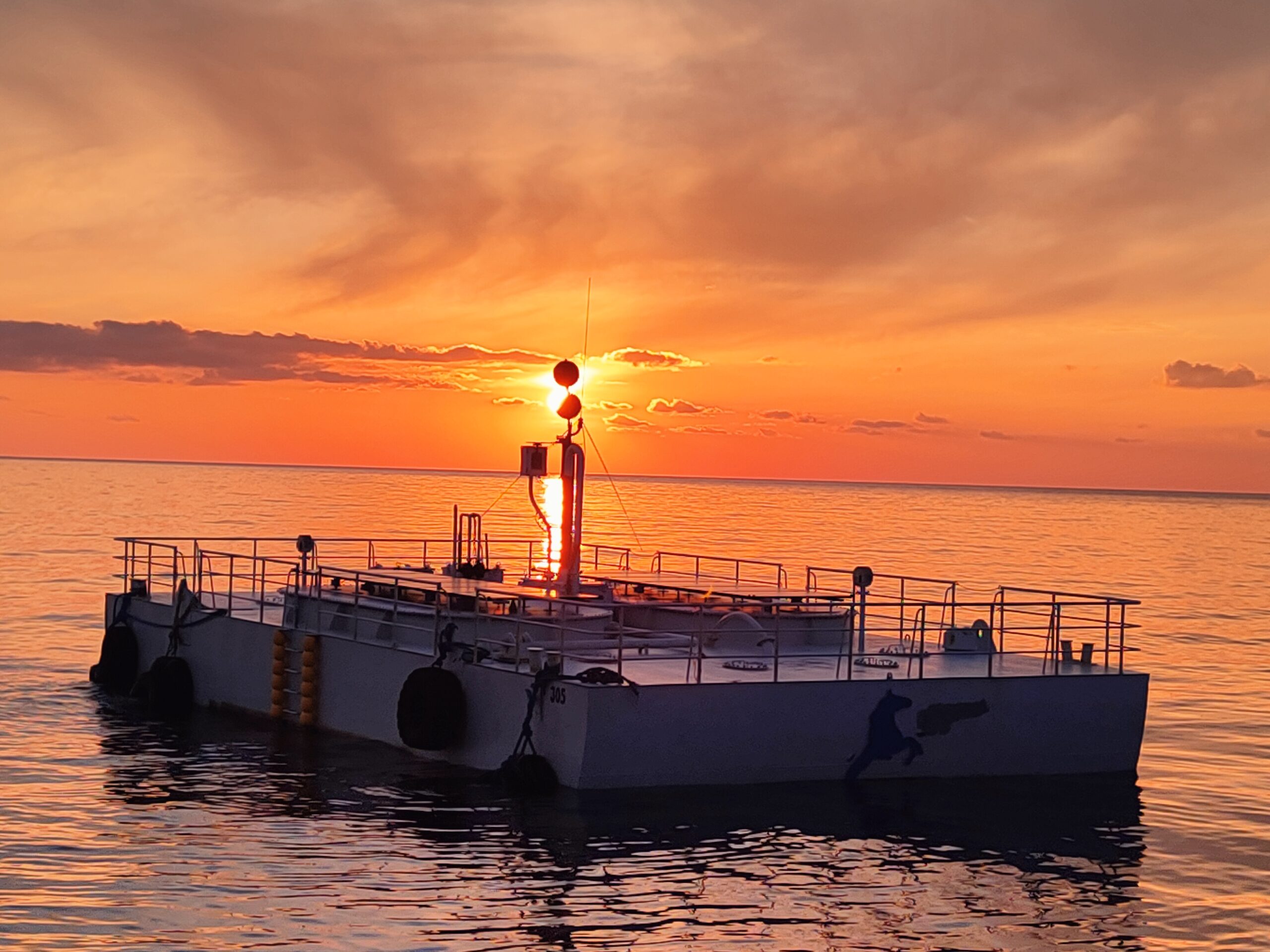
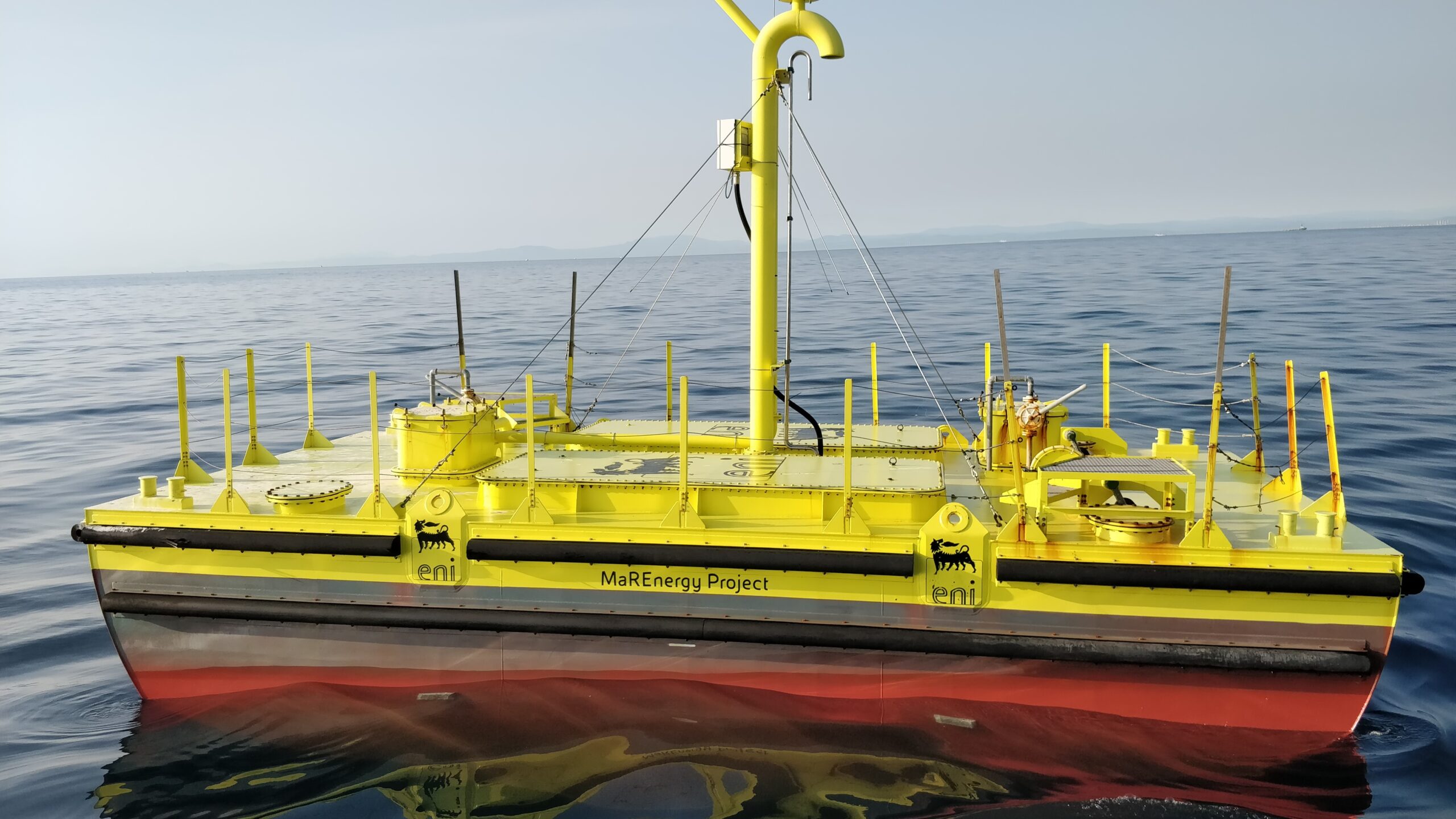
After a revamp programme that began in late 2021, the ISWEC hull was relaunched from Mazara del Vallo in early December 2022 and towed to Pantelleria, where it awaited offshore mooring and subsea cable work near Arenella. Port ordinances for December 2022 through January 2023 formalised temporary harbour mooring and the offshore work zone for laying three mooring lines and the export cable that would later energise the island grid.
Support from shipyards, diving contractors, the coast guard, and classification society RINA paralleled the ecosystem of suppliers we rely on for any Mediterranean deployment. Supply-chain delays experienced during the refurbishment underscored why hardware startups must buffer schedules for critical components.
Bridge to the 2023 grid-connected unit
Successful 2022 tests cleared the path for installation of the world’s first ISWEC connected to an island grid, announced publicly on 7 March 2023 with peak capacity up to 260 kW. Lessons on cable routing, transformer placement ashore, and outage response were captured in operating manuals shared across Eni, Politecnico, and Wave for Energy teams.
Without the December campaign, latent faults in control software or mooring components might have surfaced only after grid energisation—far costlier to remediate. Structured test programmes therefore remain central to our deployment methodology even when schedules are tight.
Instrumentation and data quality
The 2022 programme upgraded sensor packages measuring hull motion, mooring tension, and electrical output at higher sampling rates than earlier campaigns. Time-synchronised datasets allow post-processing of control decisions against incoming wave groups—a prerequisite for certifying active tuning algorithms before they govern grid-export limits.
Redundant logging onshore and offshore protected against data loss when communication links dropped during rough seas. Archiving raw signals, not only monthly averages, supports insurance claims and warranty discussions with component suppliers if anomalies appear after grid connection.
Outlook
Pantelleria now functions as a longitudinal test site spanning stand-alone prototypes, pre-grid sea trials, and operational grid-connected generation. Long-term datasets from this chain will determine whether wave energy earns a permanent slot in Sicily’s island energy plans and whether second-generation machines can scale to multiple units without proportional cost growth.
Internal readiness reviews in late 2022 also confirmed spare-part inventories, crew certifications, and emergency response contacts with Pantelleria’s port authority—administrative steps that are easy to overlook but essential before energising a grid-connected asset.
Comparing December 2022 sea states with historical Pantelleria records helps climate-adaptation planning: if extremes become more frequent, mooring and control strategies must incorporate wider safety margins without sacrificing annual energy yield.
Internal readiness reviews after the campaign confirmed that spare gyroscopic components and critical seals were stocked ashore before spring installation—a logistics lesson copied from offshore oil and gas turnarounds adapted to wave energy budgets.
Those inventories shortened commissioning time once the grid-connected unit arrived in March 2023.
Sources
Eni — The installation of ISWEC off the coast of Pantelleria has been completed (7 March 2023). Type: corporate press release.
Frontiers in Energy Research — State of the Art and Perspectives of Wave Energy in the Mediterranean Sea: Backstage of ISWEC (2019). Type: peer-reviewed journal article.
Politecnico di Torino — Blue energy in Pantelleria: deployment of the innovative ISWEC (5 August 2015). Type: university press release (historical baseline).